KATAS GEI KI SAI
KAISHU KATAS - "Empty hand Katas"
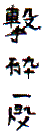
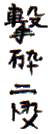
GEI KI SAI ICHI and GEI KI SAI NI - "to attack, to squash"
The kanji means "to attack; to squash; to destroy; or to demolish".
These katas are very powerful and introduce combinations of hand and leg techniques, as well as basic leg trainings.
Typical basic Katas of GOJU, called GEI KI SAI ICHI (first KANJI) and GEI KI SAI NI (second KANJI), or GEI KI SAI ONE and GEI KI SAI TWO that, paradoxically, several students of this Style don't know deeply.
About their origins, all the points converge in Master CHOJUN MIYAGI, who would have created both katas after to train - and to share experiences - with Master ITOSU.
Probably, the current form have some differences of the original ones, because GOJU RYU OKINAWAN LINE, as well as GOJU RYU of CENTRAL JAPAN LINE, wanted to differentiate these Katas with other FORMS of Chinese styles - and also Japanese - very similar.
|
KANJI
|
ROMAGI
GEI SAI ICHI |
Master SEIICHI AKAMINE - and his Maters (SEIKO
and SEITOKU HIGA) - studied deeply these Katas, reaching to the
conclusion that the base of both it was inspired from two Chinese forms of
TAI CHI CHUAN and PA CHI CHUAN
(TAI CHI SHU GEI SHO and
TAI CHI GERI GEI NI) that taught the handling of
the sword and the short sable. |
|
KANJI
|
ROMAGI
GEI SAI NI |
|
|
KANJI
|
ROMAGI
GEI SAI SHO DAN |
|
|
KANJI
|
ROMAGI
GEI SAI NI DAN |


Other important differences are: the technique in which the KIAI are emitted; GOJU RYU simplifies the techniques arguing a supposed bigger forcefulness and effectiveness; and In KENSHIN RYU Style the first Kata differs more flagrantly of the second.
FERNANDO PRIETO
7th. DAN