KATAS SANCHIN and TENSHO
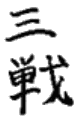
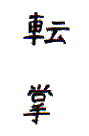
Both are typical katas of Goju-ryu, but, because of several different reasons (one of
them its excessively soft execution), "Tensho" is not trained, nor
taught, by many practitioners of this style. Perhaps - only perhaps - it could be
valid to harden "Tensho" (as well as to soften
"Sanchin"), but
it will never be valid to ignore these two katas.
"Tensho" and "Sanchin" distinguish the Goju-ryu, and
both katas will always make possible this style of Karate-Do.
As the day and the night, Sanchin and Tensho complemented themselves.
Then, in spite of their differences, both katas have many things in common, being the
most important coincidence the fact that both pursue a single horizon.
|
In the same way that it happens with many others katas, it exists different ways
of executing Sanchin and Tensho. Different paths (enbusen), and
different techniques are possible, but, especially in these two katas, this is not
the important thing. |
|
The elimination of all external distraction, in order of only concentrating on the
purpose of the kata. A good mental concentration duplicates the yield. A very good mental concentration
triplicates the yield, or quadruples it. An excellent mental concentration elevates
the yield to the umpteenth power.
To coordinate the breathing, and to synchronize it with the muscular activity.
When extending the arms, when exhaling, and also when hitting, but always maintaining
50% of the air in the lungs (it is very important to make sure of never being without
air in the lungs).
When inhaling, the body should be slack and relaxed. When exhaling, the body should be
strong as a root.
To hear the own breathing and to be aware of each part of the body. This helps
to concentrate, and also to direct the Ki (energy) toward where the own will wants it.
To maintain a constant muscular contraction, but that at the same time it can be
flexible, and to maintain also a muscular concentration, in the trapezes muscles; in
dorsal muscles; in pectoral muscles, and in abdominal muscles. In " Sanchin " the contraction should be stood out, but it is an
error to believe that in no moment of its execution there is flexibility. In the same
way it is an error to believe that in no moment of Tensho's execution there is
contraction, and concentration, although it is true that the flexibility should be
highlighted.
To stimulate - and to achieve - a perfect breathing cycle, the dorsal thorn should
be parallel to the stomach.
This is very important for the achievement of two of the main objectives:
" the benefit of the mental health, and of the physical health."
The five previous concepts, drive us toward a very important purpose:
"
the development of the intern force, and of the intern energy, through the execution
of the kata " .
The movements of the feet should be similar to those used when walking.
The steps begin naturally. The traffic must be flowed, and must be relaxed, and the
conclusion should be strong.
A firm final posture, will allow that the hands techniques, and the arms techniques,
have the required effectiveness, always based on the best possible balance.
Through the uniformity and softness will be achieved that each step could be
identical to the previous one.
The tip of the back foot will be on-line with the heel of the forward foot, while the
opening between one and another foot will correspond to the width of the shoulders.
It will always be maintained the best possible balance.
The displacements of the feet (forward, and back) will draw the form of a half moon in
growing phase, while the knees will be moved smoothly, and maintaining a light
flexion, with the purpose of never to lose the balance.
The muscles of the legs will be firm, but with the enough flexibility to allow the
mobility, and the permanent domain of the center of gravity.
The legs, and the feet, have for the body the same importance that the wheels of a
locomotive have. For what it would serve a solid locomotive, without wheels that move
this locomotive ?
These last four concepts - and the five previous - drive us toward the most
important purpose:
" to achieve that through the mental peace, and through the internal harmony,
any victory could be possible". The security; attitude; concentration;
attention; stability; force; elasticity, and balance, improved through the execution
of
the kata, will feed an internal strength, and an internal energy, that will allow us
to conquer any occasional rival, but, even most important, to overcome any stone
that the life puts us in our road ".
Several of the previously mentioned concepts, not only are appropriate for the katas
" Sanchin "
and " Tensho ", but for any kata.
The following concepts are also applicable for any kata - and in front of any
occasional opponent - but even more important as an attitude in front of the life
:
The mind should always remain calm, but should also remain always alert.
To maintain special attention, so that could be possible to observe everything that
we can not see at the first sight.
To use the outlying vision.
To maintain the calm when facing the opponent, anyone could be the power he has.
To use postures that allow a good and flowing mobility.
To denote trust and security in oneself, specially in the corporal language, and in
the facial expression.
The anger is the worst in the enemies. A pause for the reflection is the best remedy
for the anger.
It is important to have conscience of the place that we occupy, as well as of our
own limitations.
The patience is the base on which it rest the security, and a long life.
Cause and effect can be mutually harmonic, and compatible.
To despair is not an attitude of intelligent people.
The future's success, is built on the past errors.
Today's success, is the result of the wisdom and the effort.
Two last considerations about the use of the hands - and arms - and about the balance:
The hand's techniques, and arms's techniques, require a good use of the whole body.
In the same way that a tiger uses the force of his body in order of demolishing its
prey, while his claws catches the prey in order of not loosing it, our body generates
the power, and our hands serve as instrument for the contact.
When it is hit with the tip of the fingers, the biggest effectiveness is only gotten
if the four fingers are hermetic and firmly united, supported on the thumb (washi te).
The mental balance is a reflex of our interior. The physical balance is achieved
through the training of some exercises. In order of achieving an excellent physical
and mental balance, we should be very critical of ourselves.
The physical balance is one of the first requirements to achieve the improvement.
The mental balance is the first requirement to achieve the wisdom of the Masters.
Through the domain of the physical balance, it is possible to be able to weaken the
rival's posture, and then it is also possible the fact of getting easy advantage, in
order of attacking him with decision.
If somebody tried to take or to capture us by surprise, we will escape using all our
abilities, and forces. But before our counterattack, we must re-establish our balance,
in order of being possible to control our opponent.
However, the strategy to continue is dictated by different circumstances. Here it is
where the mental balance should take the protagonism.
It could be good to use evasive techniques when somebody attacks us strongly, and
while he continue in this way. But it is also good to know how to begin a
counteroffensive, in the moment when we perceive that our rival is exhausted. In the
same way many times it is good to use techniques of anticipation.
If we maintain the physical and mental balance, nobody, nor anything, it will be able
to conquer us.
Our external physical posture (from the head toward the feet) it should be perfectly
balanced, so that the techniques of hands and arms can be complemented with our
displacements, and our postures.
Our internal balance it will get us to irradiate energy with the imposing force; the
great heat - and the intense brightness - of the sunbeams. But also will get that we
know how to maintain the serenity; the freshness, and the soft clarity, of the Moon.
|
|
As the Sun and the Moon make possible the life. As male and female they make
possible the procreation and the preservation of the species. As the poles, in
spite of the distance, or perhaps thanks to the distance, both make possible the
balance of our planet. As white and black when unite themselves make possible the
gray color, to show us that it exists, and that we can walk, the path of the
balance. In the same way " Tensho " and
" Sanchin " make possible the Goju-ryu Style. |
|
It is very important to follow the concepts and principles mentioned to achieve the
best benefits in the katas " Sanchin " and
" Tensho ", beyond the duality that one kata is a hard form (Go), and
the other one is a soft form (Ju).
Let us ourselves to walk our road, but also let us ourselves be not impatient. The
patience is a virtue and to achieve the Wisdom it is very far from the principle of
the road.
Let us always follow the teachings of our Masters, but let us
always have clear that, already Masters,
we will always continue being students.
FERNANDO PRIETO
6th. DAN