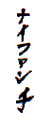
KATA NAIHANCHI
Form that MASTER Akamine took from SHORIN RYU, because he consider it very useful to
training lateral displacements, and balance.=
This Kata takes its name from the predominant position (most of the styles execute it
in this position), and - although initially existed only one Kata with this name -
Sensei FUNAKOSHI (from SHOTOKAN Style) modernized it and named TEKKI. He divided it in
three forms: TEKKI SHO DAN; TEKKI NI DAN and TEKKI SAN DAN, and now - as consequence -
some styles also practices NAIHANCHI SHO; NI and SAN DAN. In the last one, some of
this syles have added the position HACHI JI DACHI.=
The original name would be NAIFANCHI (undoubtedly Chinese), but because of for
Japanese language the sound of the letter "F" doesn't exist, it was called
NAIHUANCHI or NAIHANCHI, to adapt its name to the Japanese
pronunciation. Then, NAIHUANCHI or NAIHANCHI would not have a literal translation from
Japanese to Spanish.=
TEKKI - Japanese name that supposedly arises from the conjunction of two words in
Romagi - it is from difficult translation to Spanish, but it is known that Japaneses
called in this way to the war airplanes.=
The position is similar to SHIKO DACHI, with the same opening and with the feet toward
out, but with the legs making pressure toward inside.=
KENSHIN RYU Style called it "HITO NAIHANCHI DACHI" or
"HITO ASHI DACHI", that it means the following thing: HITO = STEP;
ASHI = LEG and DACHI = POSITION.=
KENSHIN RYU - Style created by Shihan Seiichi Akamine - teaches the original version
that arise from SHURI TE, Style that took it from Chinese martial arts. In fact
Chinese people think - and KENSHIN RYU Style totally agree - that this Kata is very
important because through the lateral displacements accustom the performer to not to
leave back, that is the first thing that by nature makes when he defends, but toward
the sides; in order not to stay in the line of the rival's attack and also to be at a
good distance to throw the counterblow.=
Chinese people accustomed to execute this Kata - and the application (BUNKAI) of each
one of its techniques - on ships, or on the edge of cliffs, or against a wall (so that
it was not possible to exit back), and Master Akamine added the modality of practicing
it first on a line traced in the floor, and later on the trunk of a fallen tree, or on
a cornice, as form of training the balance.=
Although they seem simple, they are Katas very difficult of executing and - in
SHOTOKAN - TEKKI NI DAN and TEKKI SAN DAN become trained starting from black belt,
2nd. DAN.=
| KATAKANA | ROMAGI | KANJI | ROMAGI |
|
NAIHANCHI or NAIHUANCHI |

|
TEKKI |
FERNANDO PRIETO
6th. DAN
PRESIDENT JKF GOJU-KAI URUGUAY