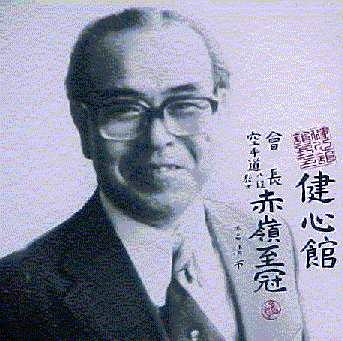
MASTER AKAMINE BIOGRAPHY = The true history Master Akamine (1920 – 1995), was born in Naha, Okinawa, and - when he was five years old - he left this island with his father and his grandfather . As well as many other okinawan people, they traveled to Central Japan to work, and to get a better condition of life for their families. Master Akamine lived several years in Kawasaki (Japan), where he met Master Seiko Higa (direct pupil of Master Chojun Miyagi); Master Kanki Isumikawa (direct pupil of Master Seiko Higa); Master Shinpo Matayoshi (founder of Kobudo Matayoshi's style), and Master Seitoku Higa (founder of Bugeikan). Some time before the II world war, and after the same one (forties and first half of the fifties), Master Akamine trained Goju Ryu with Kanki Isumikawa and Seiko Higa; Shuri Te with Seitoku Higa and Kobudo with Matayoshi, in Sensei Kanki Isumikawa's dojo. Master Seiichi Akamine – well-known as Shikan – was an expert in Goju Ryu’s line of Masters Seiko Higa and Kanki Isumikawa, and also in Master Takemura's Shuri Te; but was Master Seitoku Higa (Bugeikan) who more influence had in his karate. He also was friend of Master Seiken Shukomine (founder of Gensei Ryu), who was student of the famous Takemura's pupil called Soko Kishimoto. Living in Kawasaki, Master Akamine created a new method of teaching the style Goju Ryu. This method was knows as "Shikan Ryu", and it was a conjunction of Kanki Isumikawa’s Goju Ryu, Seitoku Higa’s Shuri Te, and several important fundaments of Shito Ryu; Uechi Ryu and Aikido. Master Akamine specialized in the University of Tokyo in physiology and human anatomy, studies that – the same as his karate training – were interrupted by the Second World War. During the War, he signed up as telegrapher in the Japanese armada, and when concluding the same one he continues his karate training in a city relatively close to Tokyo (Ito, Shizuoka), where he also specialized in Shiatsu; Reiki and Do In . Master Akamine had never agreed with the war, and he was very affected because of the misery and destruction that the same one brought to Japan. Then – visibly in disagreement with the Japanese imperial system – he decided to emigrate to Brazil, invited by the Japanese colony resided in San Pablo's City. Then the method "Shikan Ryu" - of teaching the style Goju Ryu - was introduced in Brazil by Master Seiichi "Shikan" Akamine, when in 1957 he arrived to this country. At that moment - and from 1947 - he was 8.º Dan received from Budokan, and Shuseki Shihan, received from Kanken Toyama, and both grades were recognized by Dai Nihon (Nippon) Butokukai).. After a short demurrage in Santos City, he moves to San Pablo City where – from 1958 to 1964 – teaches his Karate system in what was called "Karate Do Goju Ryu School", that later on would transform in the Brazilian Association of Karate (A.B.K.), from he would retire because of not agreeing with the political maneuvers of sport Karate. Sensei Seiichi "Shikan" Akamine was the first Great Master that introduced karate in Brazil, but when he retired of the A.B.K. other professors - and karate Associations - already existed, toward his oldest students emigrated. Master Akamine continued teaching Shikan Ryu directing small dojos in San Pablo City - helped by Sensei Tadao Saito - and applying his knowledge obtained in the University, because his services in these disciplines were very required. It was also the first Great Master who – by early of the sixties – introduced Karate Do in Uruguay, where exists a School called Toku In Kan, directed by one of his oldest and appreciated students, Sensei Juan Carlos Rius (well-known as Sensei Pa Chi). Regrettably - ending the seventies - he suffered an hemiplegic attack, that forced him to retire of the active training of Karate. Besides his university specialization, Master Akamine was a specialist about I Ching, and he had been devoted to the study of the numerology and symbology. He should support six hemiplegic attacks, and - appealing to all his knowledge - he was able to recover one and another time. But regrettably he was forced to retire totally of the Martial Arts teaching. Regrettably – because he was not as leader - his most advanced students began to apply their particular interpretations, getting lost the essence of the "Shikan Ryu", style that today it has practically disappeared. In Uruguay, the Shikan Ryu evolved toward a new style called "Kenshin Ryu", but conserving its essence and its fundaments. Master Akamine gave special importance to the Ido geiko (walks in Sanchin; Neko ashi and Shiko dachi), and the base of his karate style were the "Godan Katas" (Uke, Enpi, Tsuki. Tekatana and Teisho Godan). He also taught Kobu jutsu (kihon bo; Yakusoku bo-kumite; Sai jutsu; Yakusoku sai-bo-kumite; Shusi non kon; Tawada non sai; etc.) His favorite techniques of basic kihon were Oi tsuki; Gyaku tsuki; Mae geri; Sokuto geri; jodan, chudan and gedan defenses with counterblow of gyaku tsuki, and trainings in Neko ashi dachi to develop agility and speed of displacements. He also insisted with tai sabaki; nukite and ippon ken blows, and Nage Waza's techniques. Besides the Godan katas, the first katas that he taught in A.B.K. were Geiki Sai Shodan; Geiki Sai Nidan; Saifa; Naifanchi; Sanchin; Seionchin; Ryufa; Tensho; Seipai and Kosokun (Kenshin Ryu), and running the time - when he created Kenshin Ryu style - he added Sichi Keri Kata; Kuruunha; Shisoochin; Sauseiryu; Shuparunpei and Ken Washi In Ryu. Naifanchi (developed by Takemura with the name Naihanchi); Ryufa (developed by Takemura with the name Passai) and Kenshin Ryu (developed by Takemura with the name Kosokun), are old katas - of Chinese origin - that he learned with Seitoku Higa. After left the A.B.K. (in the seventies), he began to teach Kanshu and Uechi Seisan (one of the versions of Pangainoon Seisan) - both katas also of old Chinese origin - that were developed by Kanei Uechi and Seiki Itokazu. These katas were also taught by Aragaki and Seitoku Higa with the names Dai Ni Seisan, the first one, and Seisan te, the second one. His combat techniques (kumite) favorite were the combinations of kake uke with grabs and mae geri; kake uke with nukite, teisho uchi and gyaku tsuki (or ippon ken); and kake uke with nukite, teisho uchi, mae geri and gyaku tsuki (or ippon ken). His preferred weapons were the Sai and the Bo, and his favorite Koobudo's training were the kihon katas of Sai and Bo. Kihon Bo kata; Sunakake no kon; Shushi no kon; Sakugawa no kon; Ken Washi no Bo; Shirotaro no kon; Tsuken Shitahaku no Sai; Tawada no Sai - among other - were his favorite katas of Kobudo. He was also a Great Master of Katana (iai do and ken jutsu), and of Jo (Shindo Muso ryu). On the contrary of other karate Masters, Sensei Akamine was a person of wide mind. While most of the Masters taught a single style, Master Akamine was devoted to the teaching of the basic principles - and the roots - of the Okinawan karate, and because of that reason his system "Shikan Ryu" was a conjunction of everything that he found useful in different styles. Master Akamine was very respected in Japan, and in the wall of his bedroom it hung a diploma that said the following thing: "The hands of Akamine were never conquered in a karate fight".
FERNANDO PRIETO 8.º DAN KENSHIN RYU = TOKU
IN KAN |
|---|
English / Biographies
Master Seiichi Akamine
MASTER AKAMINE BIOGRAPHY = The true history Master Akamine (1920 – 1995), was born in Naha, Okinawa, and - when he was five years old - he left this island with his father...