GODAN KATAS = THE BASE OF
KENSHIN RYU STYLE |
 |
Most of people that train, or knows, the Kata Uke
Go Dan, believe that it was created by Master
Seiichi "Shikan" Akamine, but this is not exactly in this way.
Master Akamine trained several styles, but in the one that he was more comfortable it was the GOJU RYU. His first Goju's Master was Kanki Isumikawa - who was student of Chojun Miyagi (creator of this style) - and later on he knew Master Seiko Higa (one of the most important Miyagi's students), from who Master Akamine received his 4th. Dan. Later on his road put him in the way of another great Master, Seitoku
Higa, who - in kihon's training - taught a series of
crisscross displacements, while simultaneously different arm
techniques were executed. When he cames to Occident, Master Akamine saw that the Western
people didn't adapt very well to the education systems practiced
by the Oriental people, and that there were a jump - and a very
big hole - between the KIHON and the GEI KI SAI, that were the first
ones katas that - as such - were trained. Jointly with UKE GO DAN - and always based on existent forms - Master Seiichi Akamine structured another two Katas to those he called "ENPI GO DAN" (five elbow blows) and "TZUKI GO DAN" (five variants of fist blows and two variants of ippon ken, structured in five sequences or times). Years later, observing that Western people had difficulties of
adaptation to the open hand techniques, Master Akamine created
another two katas that he called "TE
KATANA GO DAN" (five blows of border hand),
and "TEI SHO GO DAN" (five techniques of
palm hand). Around these five katas, and seven leg techniques, Master Akamine structured a series of kihon exercises that, together with a calisthenics and a scientifically studied gymnastics, conformed a new teaching method - of the style Goju - that we can affirm it was developed iin occident. Finally, he decided that this new method became a style in
itself, and he called it "KENSHIN RYU". |
KERI KATA AND THE SEVEN
KICKS
OF KENSHIN RYU STYLE |
||
Legacy image unavailable in the archive |
Karate is not a martial art characterized by its leg's
techniques. As the meaning of its name indicates (empty hand),
Karate puts the accent in the arm's techniques, using only those
kicks that each style understands are the most effectives. |
Legacy image unavailable in the archive |
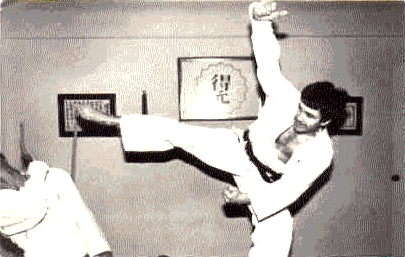 |
In "KENSHIN RYU style", five of these kicks have also the variant known as "TOBI GERI" (FLYING KICK). Sensei Juan Carlos Rius ("Pa Chi"), understanding that in the katas of Kenshin Ryu style there was few kicks, created a kata to the one he called "SHICHI KERI KATA", that contains the seven leg's techniques that Master Seiichi "Shikan" Akamine had chosen as the most effective. Although he authorized to use the name "SHICHI KERI KATA" (Chinese pronunciation of the Kanji), because of his believes and knowledges of KAETE, Master Akamine preferred the name "NANATSU KERI KATA" (Japanese pronunciation of the Kanji). "SHICHI KERI KATA" or "NANATSU KERI KATA" - and the seven kicks that it shows - are other characteristics that distinguish "KENSHIN RYU" of the rest Karate's styles. |
 |
Fernando Prieto
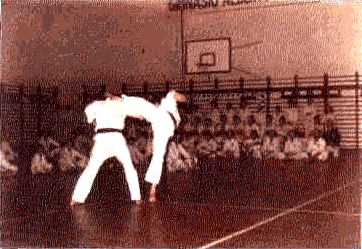
and student (mawashi tobi geri) |
Fernando Prieto
and students (jodan mawashi geri) |
Fernando Prieto, 7th. Dan |
REPRESENTATIVE of JKF GOJU KAI (Osaka/Japan) |
REPRESENTATIVE of TRADITIONAL RYUKYU OKINAWA-TE and KOBUDO FEDERATION (Naha/Okinawa) |