KAMI and TENGU
KAMI is the sound of a Japanese kanji whose western translation could be Divinity or God. But the meaning of the Japanese word Kami cannot be considered in the same way that the meaning of the word God in West.
There are Superior Gods adored by the man's faith whose powers are above the nature. These Superior Divinities are called Kami Sama. Kami Sama's western translation could be "Honorable God", but both kanji joined (Kami and Sama) conform the concept "Celestial Divinity".
The High and Venerated Goddess of the Sun, Amaterasu-no-Mikoto-Kami Sama, is the highest divinity.
The Venerated God of the Ocean and Tempests (Susanoo-no-Mikoto) and the Venerated God of the Moon (Tsuki-no-Mikoto) they are also Kami Sama.
Izanagi was the first man and Izanami the first woman. Both gods of the winds (who were born from the first Gods) beside brothers they were husbands, and from their union several gods were born. When the last son was born (the god of the fire), Izanami died because of an infection in the urinary bladder, and she passed to live in the darkness's Kingdom.
Izanagi killed the god of the fire, and he traveled to the Kingdom of the darkness to rescue his sister and wife.
But, when having drunk water of the dark place, Izanami had been contaminated of wickedness's, and the return door had been closed for her. Persecuted by own Izanami - and some other creatures - Izanagi escaped from that dark place and he purified himself taking a bath in a lake. From this purifier bath, were born Amaterasu, Susanoo and Tsuki, who became in the rulers of the universe.
There are other inferior divinities that are also Kami (without the honor suffix Sama), whose powers are above the man's control. For Japanese people all power above the human control it is Kami.
The thunder, the hurricanes, the earthquakes and the dragons are Kami.
Some human spirits are also Kami. Hachiman Shinja is the temple where are the mortal rests of Emperor Ojin, and his spirit is considered as Kami.
Some supernatural animals as Ryu Fa (the universal winged snake, or dragon) are Kami too.
It is considered that some earthly animals as the tiger (Tora), the eagle (Washi) - and some other ones - they are possessed by a Kami, and therefore they can develop the power of its Kami.
Some human beings can also be possessed by a Kami, and then they can develop its power too.
The concept of Kami can also be expressed through the kanji Jin, and Shin, and from this sound (shin) it comes the name of Shintoism (one of the most important religions in Japan). Likewise, the temple where the cult toward Kami is professed is called Shinja (Jinja), and the way toward Kami it is called Shinto.
Because of the influence of Confucianism and Buddhism, the Shintoism was divided in two tendencies: the State Shintoism and the Sectarian Shintoism.
The State Shintoism instigated toward the patriotism built around the emperor (considered descendant of the Goddess of the Sun) and it was disappearing after the Second World War.
On the other hand, the Sectarian Shintoism continues being practiced today, and each sect has a Leader who teaches the religion and the cult toward Kami. Sometimes the Leader create a Kami and he chooses its name.
If a monk of Shintoism with an initiation of Kami is a martial artist, he can choose the name of a Kami for some kata - or waza - and he can invoke a good power or a bad power for both exercises.
TENGU are lower level's divinities, that represent the elementary energy, and the intelligent power of the nature.
The Tengu are goblins of the forest and mounts, and they are considered as transformations of the Shintoism's deity Yama no Kami.
In China they are called TIENKOU, name that comes from Tiangou (the Chinese god of the mountain).
The western translation of the Chinese kanji Tienkou could be "Celestial Dog", and this denomination refers to the constellation "Canis Major", that rules the rainy station on the old north hemisphere.
From one of the stars of this constellation, were born the 108 stars of magnitude alpha of the old celestial Chinese map, that are known as the 108 elementary beings (or celestial beings).
The star "The Black Emperor" is a Tienkou.
The star "The Master of Shang San-Feng of the Wudang mountain" (incarnation of the Great Bear's constellation (Ursa Majoris) it is also a Tienkou.
Although the western translation for the Japanese kanji Tengu could also be "Celestial Dog", some Japaneses prefer the concept "Celestial Rain".
The rain; the rivers; the waterfalls; the ray; the fire; the volcanos, and other powers of the nature, are Tengu too.
Some Tengu emanate from the Superior God Susanoo-no-Mikoto. These Tengu are very powerful, and they are at the same level that the inferior Kami. Besides of being very skilled in the fencing art, they can incorporate themselves in human beings, in birds and in animals, and they are represented by human figures with distorted human faces, or with birds heads, or with animals heads.
The Tengu are the protectors of the Martial Arts. Then sometimes they punish the arrogant monks and the arrogant samurais, and some other times they reward those men who they consider worthy, being their mentors in the art - and strategy - of war.
The Bird Man Tengu is a very skilled warrior who punishes those who abuse of their knowledge and authority, wanting to win fame or position, as well as those warriors who boast about their victories.
One of the oldest Tengu is Karassu Tengu (Crow Tengu). This Tengu kidnaps men, and later return them in a insane state called Tengu Kakushi that it means "hidden by a Tengu". Another type of Tengu is Yamabushi Tengu, or Mountain's Monge Tengu. This is a protective Tengu that can become man; woman or child, and also can appear as hermit, or as a wandering mountain old man.
Tessugo Tengu (magic Tengu) and Inari Tengu (female Fox), can also take human being's figure.
Minamoto Yoshitsune, the great warrior who helped his brother Yorimoto in order to defeat the Taira Clan and to establish the Kamakura Shoguns's government system, was trained in sword art by Sojobo Tengu (the Tengu of white hair) who was the Tengu of King Kurama.
Senso Tengu is the Tengu of the wicked spirits; of the disasters; of the calamities and wars
Kaze non Tengu is the Tengu of the winds
Bioki non Tengu is the Tengu of the illnesses
Ai non Tengu is the Tengu of the love
Shojobu Tengu is the Tengu of the natural heat; volcanos and geysers
Karassu Tengu is the Tengu of the prey birds and rapine birds
Tatseru Tengu is the Tengu of the creation
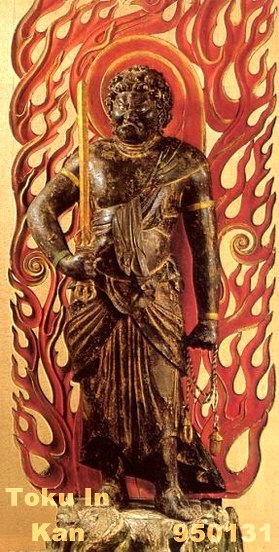
Fudo Jyorakuji Tengu
The following lines are summarized from one of the chats that we maintained with Master Seiichi Shikan Akamine.
To arrive to his answers, have been necessary the following translations:
= our questions toward Master Akamine's family (from Spanish to Portuguese language);
= the later translation to Japanese language from the family to the Master,
= and finally the inverse path from Master's answers toward us.
Then, we will try to be the more faithfulest that it could be possible about Master's answers
Sensei Akamine and his wife Shizuko
QUESTION Sensei, we want to make you some questions about our style and ours kata.
Some of your elder students say that you taught Goju Ryu, others says Shikan Ryu, and we says Kenshin. Did you teach more than one style ?
ANSWER Oh, the styles !
Years ago, the style was what the Sensei wanted that the style was. Later most of Sensei joined in associations, and the styles became what the associations wanted.
Higa said that Miyagi had not chosen Goju as name for his style, but as a philosophical concept. Other styles were too hard, and he wanted to differentiate his style. Higa also said that Miyagi hardly taught Tensho, and therefore his most advanced students learned different versions, and the rest of students almost didn't train this kata.
However, the karate organizations say that Tensho is one of the most important Goju's kata.
Higa said that the style of Miyagi was Hanko Ryu, that it means half hard style (semi-hard) or not so hard style. But other students called the style as Miyagi Ryu.
Then, if Miyagi gave so little importance to Tensho and if his main students didn't say to train Goju, Miyagi's style it was really what the organizations say ?
QUESTION Then Tensho is not an important kata ?
ANSWER Today it is a very important kata, but not years ago. Because of its softness, it was considered as a kata not virile.
Higa was very important for the consolidation of Tensho inside Goju Ryu, because he understood that this kata was an indispensable tool so that people of smaller physical power could equal the strongest people. But even so, he modified Tensho toward a harder execution.
QUESTION Then Higa taught Goju Ryu ?
ANSWER
It is what the organizations said, because the base of his karate was what Miyagi taught.
However, Higa said that the styles were not only determined by the system of training and the elected kata, but mainly by the philosophy applied by the Sensei.
Higa applied many concepts of Kenshin philosophy, as well as many techniques of Ba Ji Quan.
Once I did ask him what style he preferred. Goju or Ba Ji ? And he answered Kenshin.
QUESTION Are there differences between Higa's Kenshin Ryu and our current Kenshin style ?
ANSWER Many differences.
One of the most important is that Higa's karate had more Chinese influence, mainly from Ba Ji Quan.
The current version of Sanchin kata is not Higa's version, nor Miyagi's version, but an adaptation I made from To-on Ryu's version, which was taught me by Kanki Isumikawa.
QUESTION Excuse us Sensei because of our insistence, but we are not really sure yet about if you taught more than a style ?
ANSWER In Japan I adopted the short name Shikan, and therefore my style was known as Shikan Ryu. But, besides Karate, I taught Kobudo and - although I incorporated less techniques from Ba Ji Quan than Higa - I also applied Kenshin philosophy, although with some variants arisen from my own experience.
Among many other things, our Kenshin philosophy sustains that the performers will be more Go than Ju, or more Ju than Go, in function of their innate or acquired physical-athletic and intellectual conditions. This was a very ingrained concept in Isumikawa's karate (who hardly had Chinese influence), and I agree with this concept.
When I arrived in West, I taught exactly the same as in Japan, but the Brazilian Association of Karate granted me 8th Dan Goju Ryu, because - because of political and sport reasons - for that organization was more convenient to say that my style was Goju Ryu, and that the Shikan Ryu was an education system of this style.
When I left the Brazilian Association of Karate - because of the influence of some students as Saito; Nobukasu; Pa Chi; Mogi, Oshiro and some other one - the School became to Kenshin Kan and the style was Shikan Ryu again.
Running of the time, several changes made me understand that Higa was right, and that the true style is the philosophy that the Sensei applies. This way, Shikan Ryu evolved toward Kenshin Ryu.
QUESTION What differences there are between Shikan Ryu and current Kenshin Ryu ?
ANSWER Current Kenshin Ryu is Shikan Ryu adapted to western idiosyncrasy !
QUESTION Then, there are not differences ?
ANSWER Shikan Ryu didn't include some kihon katas, as Tekatana Godan and Teisho Godan. I had to create these katas, in order of achieving a better training of open hand, because Western people don't like these techniques.
Shikan Ryu neither included some advanced katas, as Sanseiryu; Shisoochin and Ken Washi In Ryu.
In current Kenshin, Kobudo hardly becomes trained. Only are taught some techniques of Nunchaku; Sai and Bo, but as a complement of karate teaching.
QUESTION why our Kenshin includes so little Kobudo ?
ANSWER In occident, difficultly somebody ends up being really good in Kobudo. Perhaps somebody ends up being a good juggler, but not a good warrior.
I have seen several jugglers hit themselves with their own Nunchakus. In an exhibition, so much in old times as at the present time, this would be a simple error. At the moment, in the real life this could have not too much importance, but in old times it could be to lose the combat and also the life.
Otherwise, having proliferated so much sophisticated firearms, is not intelligent to face them with Kobudo.
QUESTION Then, why we continue training some techniques and katas of Kobudo ?
ANSWER About Nunchaku only are trained some exercises to strengthen the forearms, as well as to improve and to strengthen the wrist's work.
About Sai are practiced some katas, in order of achieving more ability in the hand's techniques, while different postures and displacements of legs are executed. Also are trained some exercises in order of improving the execution and bunkai of some katas, among them Geiki Sai Shodan and Geiki Sai Nidan.
About Bo I decided to teach some kata, as way of teaching about how to control the long distances, and of improving the execution of some advanced empty hand's kata, like Kenshin Ryu and Ken Washi In Ryu.
QUESTION Excuse us our irreverence, Sensei. May we ask what degree had you when arrived to occident ?
ANSWER Budokan's 8tho Dan and Shuseki Shihan of Kanken Toyama.
QUESTION Why did you eliminate Seisan kata Seisan in our current Kenshin style ?
ANSWER Uechi Seisan is a very aggressive and violent kata. This version shows many mortal techniques, and it also invokes a really very wicked Kami.
QUESTION Can Seisan be substituted by some other kata, as Goju Ryu's version, or our style will have one less kata ?
ANSWER I indicated to substitute it by Pangainoon Seisan.
QUESTION Which is the most notorious or more important difference, between Uechi Seisan and Pangainoon Seisan ?
ANSWER The execution is similar, but Pangainnon Seisan is the Chinese original version and it invokes another Kami.
QUESTION What relationship does Kami have with the katas ?
ANSWER The monks of Shintoism put Kami's names to some katas and some wazas.
The Shintoism's monks never executed those katas without to invoke the corresponding Kami at the beginning, and when concluding they always greeted too.
This is the concept of the initial and final greeting of Shikan Ryu's katas and of Kenshin philosophy.
QUESTION The name of the invoked Kami is it always the name of the related kata ?
ANSWER No. Some kata invokes Kami, but don't take Kami's name.
Sansei Ryu invokes the fire's dragon.
Ryu Fa invokes Naka, the universal winged snake (or celestial dragon) that inhabited in the Chi'In Me Kong river.
QUESTION Is it Ryu Fa the snake kata because its techniques and execution are based on a snake, or because of the invoked Kami ?
ANSWER Because of the Kami that invokes.
But as a snake, the performer must anticipate, must deviously slither and executing low dachis; and must counterattack with unexpected nukite and with the fastest ippon ken.
QUESTION Why Seionchin the kata of the tiger is ?
ANSWER The monks who created Seionchin, they invoked the Kami Tora, and Tora is the Kami that chooses the tigers to make its incorporations.
Seionchin's execution can represent the tiger in the ibuki of its first movements; or in the speed and agility of the following ones.
The kime of this kata can represent to the fierceness of the tiger, the bunkai can represent its survival fight, and many other things can be important according to the interpretation of each Sensei.
The execution, the kime and the bunkai are very important, but the style Shikan Ryu and the Kenshin philosophy should return to the roots, and to the old traditions.
Seionchin is the kata of the tiger, because the tigers can be possessed by the Kami that this kata invokes, and because the monks who created it they invoked this Kami.
QUESTION Does all katas invoke some Kami ?
ANSWER No. Some don't invoke anything, and some others invoke other divinities called Tengu.
Peechurrin invokes 108 stars that were born from a great constellation. Therefore, for Shikan Ryu and for Kenshin the name of this kata will be Ichi Hyaku Hachi te, and not Shuparunpei.
QUESTION The Tengu also Kami are ?
ANSWER No. The Tengu are divine powers of the nature, and are the Masters of the Masters of Martial Arts.
Although I respect my earthly Masters, it was a Tengu who guided me to define my karate style, and because of this, Shikan Ryu is based on the laws of the nature.
QUESTION What would it happen if human beings fight against a Kami or a Tengu ?
ANSWER The human beings can invoke a Tengu to face it, and perhaps they can end up winning, but the human beings who face a Kami will be always conquered.
Before concluding the Second World War, the Emperor Hirohito was considered Kami, and the Kamikazes were considered his sons. This was a state maneuver in order of making believe that being guided by a god the victory would be assured.
This error was an insult for the true Gods and many Japaneses died.
Japan will never be the same country. Because of that reason I left Japan.
QUESTION What would it happen if human beings invoke a Tengu in order of fighting against a Kami ?
ANSWER From this combat could be losers the human beings who invoke them, and the misfortune could extend toward their descendants and students.
My Tengu faced the Kami of the kata Uechi Seisan, and I was weakened. Uechi Seisan never more will be executed by the style Shikan Ryu.
QUESTION Do you have more recommendations for some other kata ?
ANSWER Kenshin Ryu; Kosokun and Kushanku are Japanese simplifications of a Chinese original version called Ken Washi In Ryu.
In the same way as Kushanku was derived toward two different forms called Kushanku Dai and Kushanku Sho, also Kenshin Ryu and Ken Washi In Ryu will be executed as two different katas, being maintained the Japanese execution for Kenshin Ryu and the Chinese execution for Ken Washi In Ryu.
QUESTION How can we deepen about these knowledge, Sensei ?
ANSWER The depth of these knowledge is not taught, but can be learned.
Same as Kaete, these knowledge should not be requested, but rather must be looked for. These knowledge are in some place, waiting for somebody who deserves them. Who deserves these knowledge, will find them.
Kenshin philosophy must conserve these knowledge.
My students must look for their Tengu.
Sussunda Tengu was Higa's Tengu
Fudo Myoo Tengu is my Tengu.
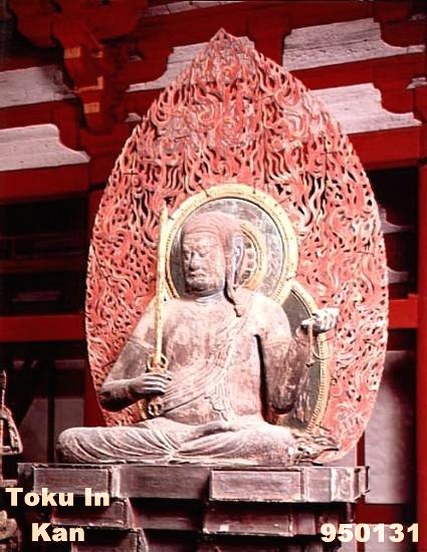
Fudo Myoo Tengu