| KANJI

KANJI

KANJI
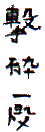
KANJI
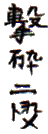
|
ROMAGI
GEI
KI
SAI
ICHI
ROMAGI
GEI
KI
SAI
NI
ROMAGI
GEI
KI
SAI
SHO
DAN
ROMAGI
GEI
KI
SAI
NI
DAN
|
|
Master SEIICHI AKAMINE - and his Maters (SEIKO and SEITOKU HIGA) - studied deeply these Katas, reaching to the conclusion that the base of both it was inspired from two Chinese forms of TAI CHI CHUAN and PA CHI CHUAN (TAI CHI SHU GEI SHO and TAI CHI GERI GEI NI) that taught the handling of the sword and the short sable.
Then, they called GEI KI SAI SHO DAN (third KANJI) and GEI KI SAI NI DAN (fourth KANJI), giving to the first one a modality "GO" (with most of the arm techniques with closed fist), and to the second a modality "JU" (with all the arm techniques with open hand).
These two Katas GEI KI SAI of KENSHIN RYU are richer than the GOJU RYU versions, since not only are executed by "empty hand", but also with weapons (one - or two - SAI), being characterized the first one because of show empty hand defenses against SAI and fist counterattacks; while the second show defenses and counterattacks of SAI against SAI.
Although GOJU RYU sustains - with reason - that KARATE don't train weapons, KENSHIN RYU thinks that it is important the practice of defenses against armed opponents, as well as the training of some weapons (SAI, NUNCHAKO and BO) as an excellent complement for the advanced students.
KENSHIN Style also argues that their form, path and interpretation, are more adjusted to the original versions, and that, as its own names indicate it, are Katas thought as base of SAI training; without stopping to recognize their utility - and importance - in the "empty hand" practice.
In KENSHIN RYU Style, both Katas shown bigger quantity of technical and postures (DACHIS), as well as big differences, with the form; execution and path - mainly in the second one - with regard to GOJU RYU Style.
Likewise, both forms are "FUNDAMENTAL" Katas for both styles, in what concerns about their "empty hand" execution.
|