KATA TENSHO
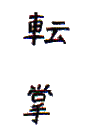
GOJU RYU can be defined as the "Style that combines the FORCE and the HARDNESS with the SOFTNESS and the TECHNIQUE".
"GO" - among other things
- it means "HARD"; "STRONNG"; "CONCENTRATION",
while "JU" - also among other things - it means
"SOFT"; "FLEXIBLE"; "RELAXED". As well as SANCHIN KATA represents the
"GO", TENSHO KATA
symbolizes the "JU". - Then both are complementary,
and I would say that are needed the one to the other one, since
in GOJU RYU anything it is completely "GO", as
neither it absolutely "JU".
Although SANCHIN kata it is FLAGRANTLY "GO", it shows
us the "JU" fundamentally in the relaxation that
takes place among each concentration, and tension, technique. In
the same way the TENSHO kata, that it is UNQUESTIONABLY "JU", it shows us the
"GO" in the stability of its
predominant posture (SANCHIN DACHI). and in the concentration of
FORCES and ENERGY that take place in the TANDEN (point located in
the HARA).
TENSHO is a beautiful KATA, ideal to train the transfer of the
ENERGY toward the arms, since shows a rich range of arms; hands
and wrist techniques (defenses and attacks), that go from blockades - and basic deviations - until the most sophisticated
techniques. In spite of its apparent simplicity - because of its
breaks; grabs; conductions; blockades of "KAISHU LINE";
blockades and/or blows of TEISHO, KAKUTO, etc., and the necessary domain of both arms perfectly coordinated with the rest of the
body - TENSHO is a KATA of very difficult execution.
If we add a
firm and solid position, and a similar techniques of concentrations and tensions practiced in
SANCHIN KATA (but with
more flexibility; ease and relaxation) - as well as a great
quantity of "JU TECHNIQUES" (that allow to equal the
gotten effectiveness applying the "GO") - "TENSHO" becomes a
very important and representative KATA of
GOJU Style.
The abdominal breathing and the path (ENBUSEN) are same that in
the SANCHIN KATA, and its name, "TENSHO", can be translated
as "HAND PALM ROTATION", being all its
techniques of "open hand".
Because of existing two LINES of GOJU RYU (OKINAWAN and CENTRAL
JAPAN), and other styles - as KENSHIN RYU and SHOREI KAN - trains
this kata, it shows some differences in its positions and
executions.
KENSHIN RYU style - for example - carries out some techniques in
NEKO ASHI DACHI, changing the front toward the same ones are
executed. KENSHIN RYU also accentuates the importance of the
abdominal breathing, adding - at the beginning of the kata - the HALF breathing. Almost when finishing the kata, the same shows
the COMPLETE breathing, similar to yoga breathing. The rest is
similar to OKINAWAN GOJU RYU version.
The OKINAWAN GOJU RYU accentuates (in this kata, and in all the
Katas) the fluctuation that should exist among all the
displacements, although these displacements are being carried out
in oneself position; for example from SANCHIN DACHI to the own SANCHIN DACHI.
Most of the GOJU Schools of CENTRAL JAPAN only execute this kata
in the position SANCHIN DACHI and - on the contrary that in the OKINAWAN version - almost without show the fluctuation in the
displacements among each posture.
Sensei Seikici Toguci (SHOREI KAN) was one of the Masters who
more deeply studied this kata, then his version could be the most
complete.
Personally I trained this kata with Sensei Pa Chi (7th. Dan
KENSHIN RYU of Uruguay); with Sensei Hidekasu Oshiro (6th. Dan
GOJU KAI of Central Japan); with Sensei Raúl and Sensei Roberto
Fernández (both 6th. DAN GOJU RYU of Chile); with Sensei
Miguel Rojas (5to. Dan GOJU RYU of Honduras); with Sensei AKIRA
SHIOMI (8th. Dan GOJU KAI of Central Japan); with Sensei YASUNORI
YONAMINE (8th. Dan GOJU RYU of Okinawa), and with some SHOREI
KAN's Professors.
I learned a lot from all of they, but who better impressed me
they were Sensei Pa Chi and Sensei Hidekasu Oshiro, because of
the depth of their knowledge; while the execution that more I
liked it was Sensei Raúl Fernández version. All of they were
students of Master Seiichi Yoshitaka Akamine, 8th. Dan and
creator of the style "KENSHIN RYU".
In synthesis, in all its variations, TENSHO is a beautiful
traditional kata that can help us to exercise the attention and
concentration of the "KI" - and how remark it - in
those places where our will want.
FERNANDO
PRIETO
6th. DAN