CHANGE OF NAMES and NUMEROLOGY
Fernando Prieto, 6th. Dan
Master Akamine was specialized in two very common techniques in old Japanese martial artist: the not well called "change of name", and the "numerology".
In Japanese language, the same names can be written in several
ways.
"To change the name" doesn't
mean to give a new name. "To change the name"
it means to write that name - in some of the Japanese
writing's form - so, in this way written, it irradiates positive
energy.
Master Akamine gave his students two white plastic cards, with their "changed
names" (sometimes written in kanjis, and some other times written in
katakana) - and a picture of Fudo Myoo Tengu - and he advised that Fudo
Tengu's picture, and one of the two cards, were hung in the main wall of their
Dojos; or in the interior part of the door of their bedrooms, or homes, and that
the other card were put in the left pocket of their shirts, or coats, (near to
the heart).
I don't know so much about this, but I think that -
beyond sharing it, or not - it is important to know this Master
Akamine's facet, that was told me by his family.
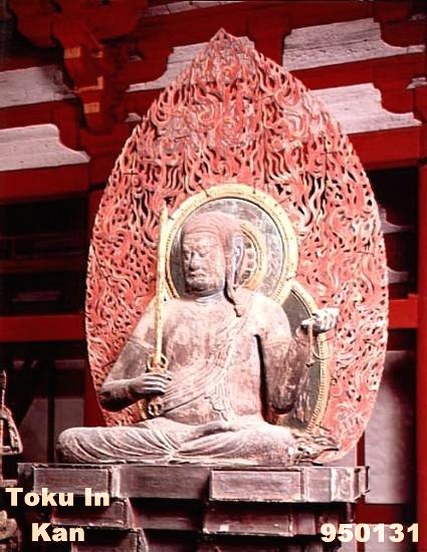
Fudo Myoo Tengu
About "numerology", Master Akamine´s family spoke to me very much.
I will try to summarize the relationship of "numerology", and the katas of our Karate style, Kenshin Ryu. We must understand that it is not importan to agree - or not agree - with these theories. The important thing it is to know Master Akamine with more depth.
Master's family told me that the quantity of times of all katas that ORIGINALLY Master Akamine incorporated in our style Kenshin Ryu, are "primary" numbers; that is to say numbers exactly only divisible between themselves and the number one.
Those who specialize in "numerology", believe that the "primary numbers" are "good numbers", and that the not primary numbers are not good ones, or - in other words - are bad numbers. The five Godan katas are divided in thirteen times and - if these katas are five - this is not by chance. Master Akamine began teaching three Godan katas (Uke Godan, Enpi Godan and Tsuki Godan) for a lot of time. Finally - when some years later decided to increase its - he didn't make it to four (that is not a "primary number"), but to five that it is a "primary number" indeed. In this way were born the katas "Te Katana Go Dan" and "Teisho Go Dan".
It is important to observe that thirteen, three, and five, are "primary numbers".
The two Gei Ki Sai katas are structured in twenty three times, and twenty three it is also a "primary number".
"Saifa" - the same as Godan katas - is divided in thirteen times.
"Kanshu" is structured in seventeen times.
"Seionchin"; "Seipai" and "Seisan" - the same as Geiki Sai katas - are structured in twenty three times..
"Ryu Fa" and "Kururun Fa" are divided in twenty nine times.
"Shuparinpei" is divided in thirty seven times (with two techniques - and times - hidden).
"Ken Shin Ryu" is structured in thirty seven times.
"Sanchin" and "Tensho" - the same as Kanshu - they are structured in seventeen times.
All the times of the mentioned katas, correspond also to "primary numbers".
But as the quantity of these katas it was "eighteen" - and this is not a "primary number" - Master Akamine added another kata called "Naihanchi".
In this way the Master increased the quantity of katas to nineteen, that it is a "primary number".
"Naihanchi" is divided in seventeen times.
This was the main reason because of Master Akamine - at the beginning - had not incorporated Shisoochin and Sanseiryu, since the katas would be increased to twenty-one, that it is not a "primary number".
Sensei Pa Chi created a kata to the one he called "Sichi Keri Kata", that Master Akamine didn't incorporate immediately into Kenshin Ryu style because of two reasons:
| 1st.) | Because Sensei Pa Chi had structured this kata in eighteen times, and this is not a "primary number". |
| 2nd.) | Because if he had incorporated it, the quantity of katas would be increased to twenty, and twenty neither is a "primary number". |
However - in spite of being a "primary number" - the Master's book of numbers, indicated that although "19" it was not a bad number, neither it was not a good number among the "primary numbers". To rectify this - and before the insistence of his most advanced students - Master Akamine incorporates "Shisoochin" and "Sanseiryu". But he also added one technique to Sichi Keri Kata (Mae Jodan Yoko Sokuto Geri), and incorporated this kata too, just as the same with the kata called "Ken Washi In Ryu", that is the Chinese version of "Kenshin Ryu kata". In this way Master Akamine took the quantity of katas to "twenty-three", that is a "primary number" too.
"Shisoochin" and "Sanseiryu" (Master called "Sansei ichi ryu"), are structured in twenty-three times.
"Keri kata" - with Master Akamine's first modification - it was structured in nineteen times, but finally – modifying the form of counting - he took the times to "23".
Although it original execution has been lost in the time, it is known that "Ken Washi In Ryu" kata's times correspond with the "primary number 43".
They are not many Master Akamine's direct students who know the execution of "Ken Washi In Ryu", and for that reason this kata is trained - and taught - only for his oldest students, Sensei Pa Chi among them.
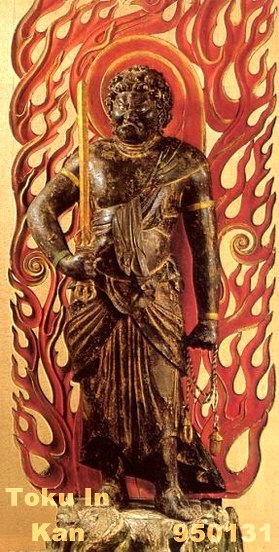
Fudo Jyorakuji Tengu