MASTER SEIICHI “SHIKAN” AKAMINE’s CALLIGRAPHY
Translation to Romagi
Kenshin Karate-Do
Daijyobu igyou tasei no tame
Shinshin tomoni kenzen nite
Nyushin no waza wo migaki
Kouketsunaru seishin no shyuuyou wo
Go shin no michi wo tassei su
Gorin no michi wo tadashi
Shidou no gotoku wo kanbi shite
San dai on wo sonshy shi
Shin no jindou toku iku ni kouken su
NOTE = Toku In Kan Karate-Do School wants to thank the transcription to our student John Alexander Piedrahita. John is our contact in Miami (USA), and this transcription was made by his wife who is of Japanese origin.
Translation of some manuscripts (edited by own Master Akamine) about "Kaete" (change of name), and about the following words : (and its numeric equivalences)
= Kenshin
= Kenshin Tettsu Daigakku
= Toku In
= Toku In Kan
KAETE = 16 lines
Kaete modifies the lines of the names, in agreement with the rules of the science of the numbers, and it is better to work on names written in kanji.
Kaete will be accompanied by Fudo Tengu's image, and it will be put in the main wall.
Kaete should be made on sculpted wood, or on plastic cards, that will be taken close to the heart (pending chain, pocket of shirt or coat), or in the internal side of the door of the bedroom, or of the home.
Only should be used three colors: black, or red, or blue.
On foreign names, Kaete should be made twice :
1) - in katakana,
2) - in kanji and hiragana (or in kanji and kana);
and should be
accompanied by two different images of Fudo Tengu.
On names written in Roman alphabet, it should be used the science of the symbols.
The science of the symbols is equally effective as Kaete. But for both systems it is very important the trust that the receptor should have in who executes these techniques (same it happen with doctors), as well as the trust that the executant should have in himself.
In the same way, it is very important the honest and positive feeling from who performs Kaete ( or Symbolism ) toward the person who receives these two techniques, as well as the reciprocity that should have the receptor.
KAETE
|
替える |
|
|
手 |
|
KAETE
|
換る |
|
|
手 |
|
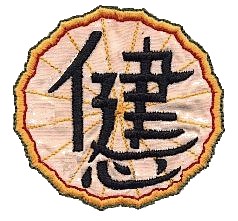
KENSHIN = 15 lines In itself, " 15 " it is a very good number. A single name of 15 lines is a good name. But the 15 lines of the old name were composed by two elements (Ken and Shin), and these two elements were not balanced in a good way. " 11 " ( the lines of Ken ) it is also a good number, but " 4 " ( the lines of Shin ) it is not a good number. In Brazil the name changed to “ Ken In ” ( 17 lines ), because " 17 " it is a very good number. Beside this, both components of this name ("Ken" and "In") also has a quantity of lines with good numeric equivalence, because " 6 " ( the lines of In ), it is also a very good number. The kanji " shin " must be modified. The longest one of its four lines must be lengthened even more, and the new name will be " Kenshin " (a single word of 15 lines).
Shikan Ryu Style's name should become to Kenshin Ryu, but the philosophy should be called Kenshin Tettsu Daigakku.
KENSHIN TETTSU DAIGAKKU = 36 lines. 36 it is multiple of 6, and " 6 " it is a very good number. (36 = 6 x 6). The first six represents the eyes, the ears, the nose, the tongue, the body and the spirit. The second six represents the color, the voice, the scent (smell), the savor (taste), the tact and the justice. In both cases, the first five concepts represent the five senses, while the spirit and the justice are related to concepts of Buddhism, and of Shintoism, about how to act in the life in order of arriving to the domination the sixth sense. |
KENSHIN
|
健 |
|
|
心 |
|
TETTSU DAIGAKKU
|
哲 |
|
|
大学 |
Gakku (8 lines) = philosophy. |
TOKU IN ( KOO TOKU.I ) ( TOKU HIKARU )
|
得 |
|
|
光 |
|
Koo Toku.i Hikaru ( name that can also be joined as Toku Hikaru ) was simplified toward Toku In in order to acquire the best protection for the name. Then, the name Toku Hikaru Kan was changed by " Toku In Kan ". The literal translation of Koo Toku.i Hikaru Kan ( or Toku Hikaru Kan ) it is " Bright and Proud Main School of the Good Habits ". But the symbolic translation of the name Toku In Kan is " Glorious and Honorable School of the Good Luck ". The name Toku In has 17
lines and it arises from the conjunction and simplification of three kanji: "
Toku ", " I ", and “ In ". The kanji " I " has 13 lines, and its translation in this case it is to continue, or to give in testament. |
I
|
意 |
|
The name " Toku In ", can also be written as is shown below, but in this case must be always accompanied with the word " Kan ".
TOKU IN KAN 徳院館 o 得院館
|
徳 |
TOKU
|
|
院 |
|
|
館 |
|
| In this case the literal translation is "Greatest School of the Good Habits", but the symbolic translation continues being "Glorious and Honorable School of the Good Luck". |