CHINTE o SHOIN
FERNANDO PRIETO
6th.DAN
PRESIDENTE JKF GOJU-KAI URUGUAY
Sometimes, the answers are in the most incredible
places, and several times in ourselves.
When I began to interest myself about the names of the katas, and several
questions came to my mind, Sensei Juan C. Ríus (Pa Chi) spoke me about
METAPHYSICS, SIXTH SENSE, LONGITUDE OF WAVE (RIPPLE), REGRESSION, INTUITION AND
CONCENTRATION. He told me that who was able to perceive the intention, and the
idea (thought), of who created the katas, could have HIS ANSWER.
In that moment, the topic didn't interest me too much, then I kept this chat in
a corner of my memory.
Some years ago, when I began to train SHOTO KAN, in order to be examined as
kata's referee, and the answers about CHINTE of several very important
Professors of Karate didn't satisfy me, I remembered that chat with Sensei Pa
Chi.
Once, at night, training some exercises of breath and of mental concentration
that Sensei Pa Chi had taught me, I fell asleep, and I dreamt with a
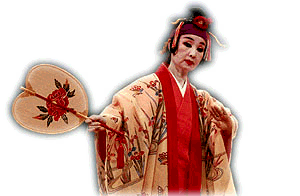
silhouette (apparently female), who with Chinese clothes, she executed CHINTE
repeatedly.
I could only see from the ankles toward head of that silhouette, while another
figure (apparently male) observed with great attention, without giving signal of
approbation. But, after several executions, his face was illuminated.
Immediately several areas appeared covered by rice's paper. The last of these
areas was marked by the path of the kata, but without a single hole, while the
performer awaited on HEISOKU DACHI, already finished the kata.
Later on, the female silhouette executed the kata again, this time with the eyes
covered by a handkerchief, and the rice's paper emerged intact again.
Then, the figure who observed, began to explain the sense of this kata,
apparently in Chinese language, and me, although I don't speak the language,
inexplicably I could understand ...
... " It is not easy to execute this kata without damaging the paper, before
arriving to the three lasts movements. But from there toward the end of the kata
begin the really big hardness, and only will arrive without hurting the paper
those who achieve the effectiveness that this kata demands, being very important
the rhythm, softness, technique, concentration and balance of the performer "
...
... " This is the only correct way of executing SHOIN ".
Apparently, in a dream, it was the first time that I had heard the name "SHOIN",
and then I had MY ANSWER. And, from that moment, this was my interpretation for
the three last movements of "CHINTE" or "SHOIN".
When again I met those Professors who had given me extraneous explanations about
these three small jumps, and with firmness and security I gave them my
interpretation, I was surprised because they agreed with me. Then "MY ANSWER"
began to be "THE ANSWER". And I was even more surprised, when they said me that
"SHOIN" had been the first name of CHINTE, because I didn't remember that
somebody had previously told me that.
Today it has been proven that, by hypnosis, it is possible the regression, and
the parapsychology has verified the possibility of the mental communication,
that would not have distances limits, nor limits of time. But surely this is not
the case.
My restlessness and permanent search of learning, in some moment will have given
me the opportunity to read, or to listen, something that was slept in some place
of my mind, and woke up in my dream.
But there are other theories, such as that the execution that today is known
would not be complete. Who sustain this theory say that several movements would
have gotten lost through the time, and that, so the Kata could finish in the
same place that begins, these three displacements would have been added, being
the biggest difficulty that these three displacements should be made with YORI
ASHI (without elevating totally the feet of the floor), in HEISOKU DACHI and
without impulse of the arms.
Sensei PA CHI sustains that these three last movements symbolize the
ellipses (suspensive points), and that, with them, those who studied this Kata
deeply wanted to give it the sensation of infinite.
One of those more strange explanations that some Professor had given me, were
that, in the course of the Kata, several bodies were inert in the floor, and
then the performer should jump above them, in order to return to the beginning
point.
Although this article was not written from the technical point of view, I hope
equally will be useful for those that like of CHINTE, and want to improve
its execution.