KENSHIN RYU |
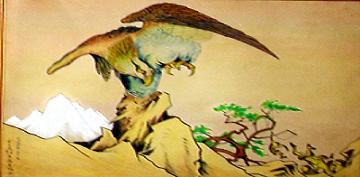
Square drawn and painted by Master Seiichi Akamine. It symbolize Kenshin Ryu (eagle kata) |
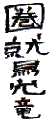
KEN WASHI IN
RYU |
 |
 |
 |
As well as SEINCHIN or SEIONCHIN represents the tiger and RYU FA the snake, KENSHIN RYU is the Kata of the Eagle. KENSHIN RYU kata is the Japanese version of a very old form -of Chinese origin- and one of the most advanced in the style that takes its name, created by Shihan Seiichi "Shikan" Akamine. It is very difficult to specify its origin, that would go back to the century 4 AD, when BODHIDHARMA (DARUMA for Japaneses) created the 18 exercises that -running the time- would transform in 72, and later on in 108, that are the base of the Chinese Kenpo and Japanese Karate-Do. In the century 14 AD, the PA KUA CHUAN developed a form called KEN SHAO LU -that translated to Japanese language would be "KEN SHO RYU"- and whose translation to Spanish language would be "FIST AND PALM OF THE DRAGON", or "FIST OF THE FIRST DRAGON", or "CIRCLE OF THE FIRST DRAGON". Then it is valid to think that KEN SHO RYU was the first name known in Japan for this kata. Later on the PA CHI CHUAN (BAD JI QUAN) adapted this kata to its interpretation, and called it RYO SHAO LU (RYO SHO RYU in Japanese language), that would mean "BOTH PALMS OF THE DRAGON", surely because of the open hand techniques prevailed in its execution, and also making reference to the WINGS of the dragon. The PA CHI CHUAN had -and has- several forms inspired in real and mythological animals, such as PA CHINTO CHI (CRANE), PA CHI RYU (SNAKE), SEIUN PA CHI (DRAGON OF FIRE), etc., and a very old form that represented the EAGLE, whose original name and execution got lost in the time. With some movements of this form that they had rescued, and based on the forms "KEN SHAO LU" (of PA KUA CHUAN), "RYO SHO RYU", "PA CHINTO CHI", "WUSHI YING KUN" -and some others (of PA CHI CHUAN)- the Masters of Japanese Martial Arts created some Katas of Kobudo and some others Katas of empty hand. One of these kata of empty hand -of SOFT (JU) execution- was called "RYO SHO KEN IN RYU" (THE PERSON'S HANDS PALMS ON THE FIST OF THE DRAGON), and other -of HARD-SOFT (GO-JU) modality- was called "KEN WASHI IN RYU", that, although word by word would mean CIRCLE (or FIST), EAGLE, PERSON and DRAGON, combining these ROMAGIS we would have "PERSON THAT CHANGES FROM EAGLE TO DRAGON AND FROM DRAGON TO EAGLE". Sensei Seiichi "Shikan" Akamine trained these Katas with Masters Seiko and Seitoku Higa, and he incorporated "KENSHIN RYU" (KEN SHAO LU or KEN SHO RYU) -also known in Japan with the name KOSOKUN- in his original style (Shikan Ryu). He gave to this form the meaning of "THE KATA OF THE EAGLE", surely because of the similarity of movements that it has with this animal. If we translated the ROMAGI to Spanish language, we would have "STYLE OF THE VALIANT HEART" or "STYLE OF FIST AND HEART", although -according Sensei "PA CHI"- Shihan Akamine would have given the symbolic translation of "STYLE OF BIG HEART; STRONG SPIRIT and HEALTHY MIND". However Master Akamine didn't taught the kata "KEN WASHI IN RYU" to all his students, but yes to Sensei Pa Chi. "KEN WASHI IN RYU" kata, from the beginning show the EAGLE, opening and beating its wings getting ready for the hunt. Then search the target and, when finds it, fixed its view and -after measuring the force and direction of the wind- she rushes flying with total determination. It shows techniques of very difficult execution –such as NIDAN MAE TOBI GERI; MIKA TSUKI GERI followed by JODAN YOKO SOKUTO GERI with turn of 360º- and it hides applications of very difficult and advanced techniques as SOKUTO-USHIRO TOBI GERI. Both katas, "KENSHIN RYU" and "KEN WASHI IN RYU", puts special attention in the intelligent and resolved attitude in the execution; in the view that should always be directed to the target instants before to assume the positions and to carry out the corresponding techniques; in the security, attention and determination that doesn't admit distractions when the rival is individualized; in the concentration and rhythmic breathing that allow the maximum yield; and in the rhythm that sometimes resembles the eagle drifting to the wind, and abruptly it changes the front and rushes to attack toward another direction. Symbolically both katas begins with defensive techniques -same as all the Katas of our Kenshin Ryu Style- and philosophically to stand out that, when rushes to attack, the eagle is defending its specie, looking for the sustenance for itself and its family, of agreement with the role that the nature has assigned. Who signs the present article, have had the honor -and the luck- of learning these Katas with Sensei Juan Carlos Ríus ("PA CHI"). |
FERNANDO
PRIETO 8th. DAN |